


2100NEWS WEEKLY CRYPTO REPORT Mar-6

The crypto index NWST1100 rose 3.41% last week. Over the past 30 days, Bitcoin emerged as the strongest relative performer, posting the smallest loss of 1.50%.
*Below, we present a standardized weekly report and next week’s outlook, prepared based on the Theory Swingtum of intelligent finance. We gauge the crypto market’s breadth and direction by showing the 2100NEWS Digital Assets Total Index (NWST1100), which measures the performance of 1100 (by market capitalization) significant crypto assets. The information-laden chart is initially complex to read, but it effectively displays essential price information, key decision-making levels, momentum, trading volumes, and crypto market breadth. Monitoring Market Sentiment and Breadth is necessary to detect early signs of trend reversals or continued strength.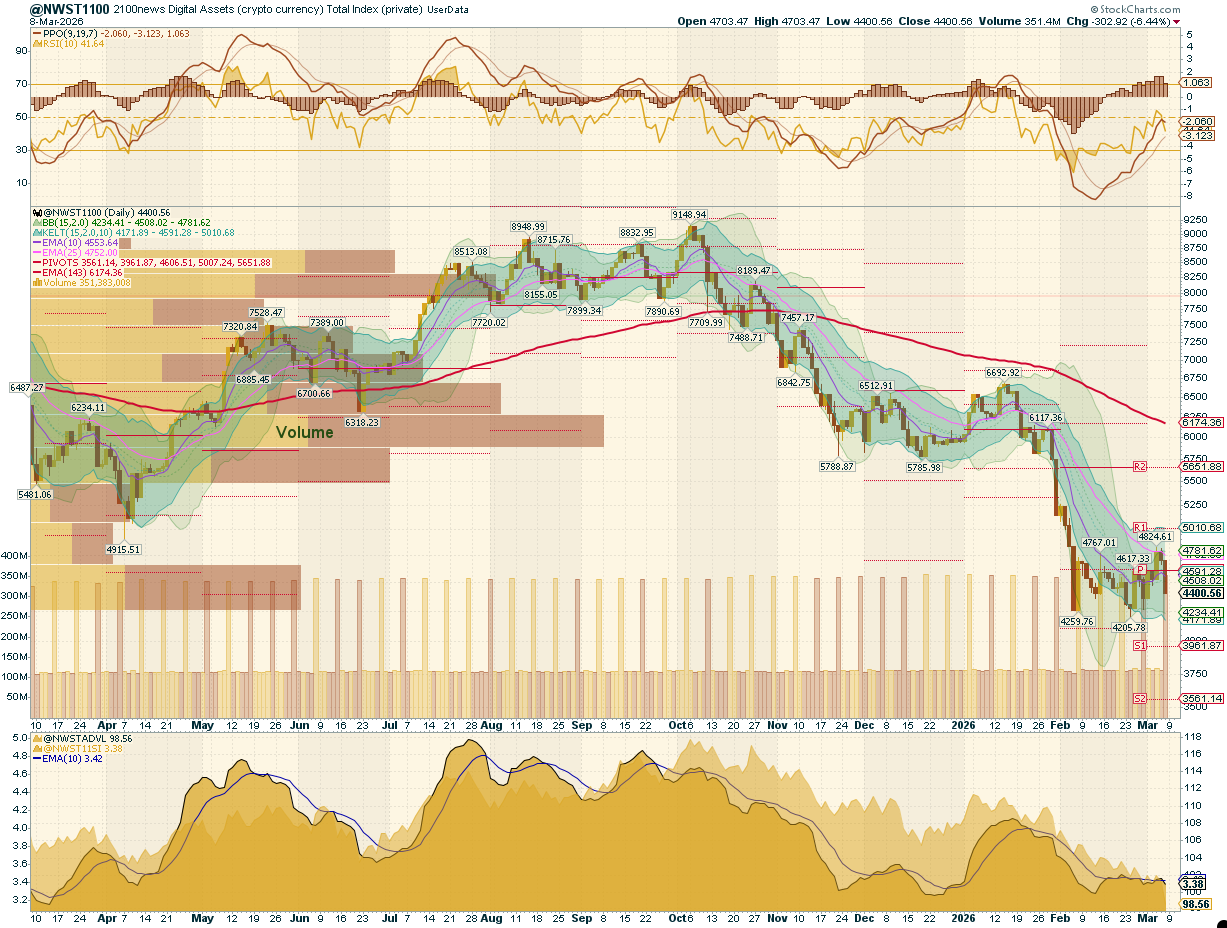
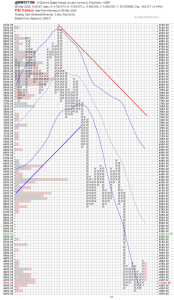
After conducting a detailed examination of the NWST1100 chart, a vital metric for the cryptocurrency market, several essential market dynamics and changes in market sentiment are revealed:
The NWST1100 index rose 3.41% over the past week, but that weekly gain masks a highly volatile internal structure. The period began with a deep late-February slide that quickly reversed into a V-shaped rebound, followed by a strong upside push into the first days of March. That rally carried the index into the 4,750–4,800 resistance area, where the market briefly shifted from repair into breakout behavior. However, the move did not hold. By the second half of the week, follow-through weakened, and price slipped back from the highs, ending the period closer to the middle of the repair range. In structural terms, the market moved from breakout enthusiasm back into cautious consolidation.
Market Sentiment (PPO & RSI): Momentum indicators show improvement but still reflect a market in transition rather than expansion. PPO lines have remained negative but upward-sloping, confirming that the higher-timeframe trend remains bearish. At the same time, the PPO histogram rolled over while remaining positive, indicating that downside momentum continued to decelerate after the prior liquidation phase. The RSI ended around 41, clearly above capitulation territory but still below neutral. This is consistent with a market in repair mode: selling pressure has eased, but buyers have not yet established a sustained expansion regime.
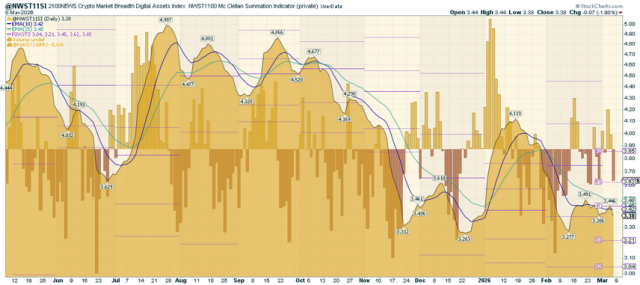
Crypto Market Breadth indicators: Breadth has improved from extreme weakness but remains structurally thin. The Advance-Decline Volume Line (ADVL), adapted by 2100News for the crypto market as ADVPL, tracks the net money volume of advancing versus declining digital assets. It weakened again into the latter part of the week, indicating that internal participation deteriorated even as the price briefly challenged higher levels. This suggests that the rebound became progressively narrower. The McClellan Summation Index, a long-term version of the McClellan Oscillator that measures market breadth, flattened and then softened slightly over the final sessions. This means internal conditions are no longer in free fall, but they are also not broadening in a way that would support a sustainable upside transition.
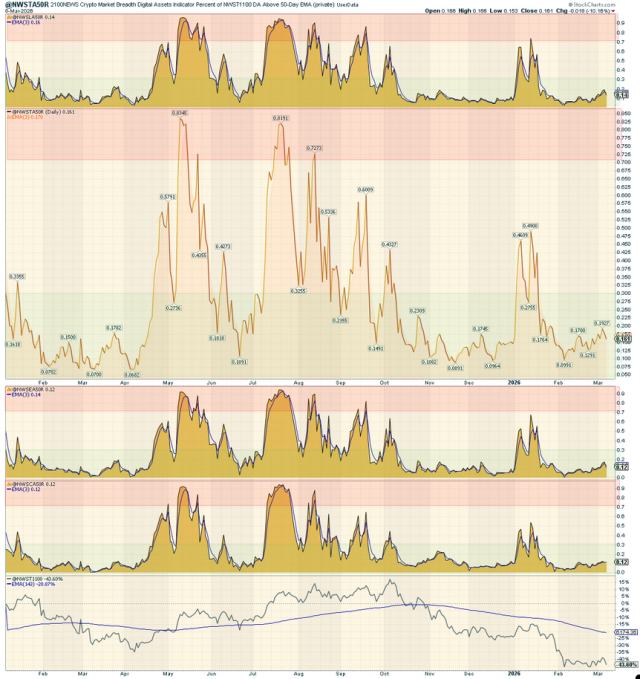
According to the chart on the right, all A50R indicators across the major segments (NWST1100, NWSET100, NWSL100, NWSCo100) have remained near capitulation territory. A50R readings — the share of assets trading above their 50-day EMAs — ended in the 12% to 16% range. The Ethereum Tokens (NWSET100) cohort remains the weakest. Large caps and the total market show slightly stronger participation, confirming that the current environment is best characterized as a repair regime rather than a confirmed trend reversal.
This breadth indicator measures the percentage of digital assets trading above a 50-day moving average.
* The percentage of digital assets trading above a specific moving average is a breadth indicator that measures internal strength or weakness in the underlying index. The chart on the right side compares the percentage of DA trading above the 50-day EMA for:
- Top panel: NWSL100 (Large Caps)
- Middle panel: NWST1100 (Total Market)
- Third panel: NWSET100 (Ethereum-based tokens)
- Bottom panel: NWSCo100 (Coins)
📉 Summary
The week of February 28 to March 6, 2026, was defined by extreme volatility, a V-shaped rebound, an early-March breakout attempt, and then a return to range behavior. Price action improved enough to lift the weekly close, but the move lacked durable internal confirmation. Momentum repaired, yet remained negative on the higher timeframe. Breadth stabilized but weakened again beneath the surface, and participation stayed thin. This remains a repair-in-range market: rallies can be sharp, but they remain vulnerable to failure at resistance unless internal participation broadens materially.
Outlook for this week
This report examines the cryptocurrency market’s short-term outlook, identifying patterns and signals that may offer insights into potential market direction. While predicting market behavior is inherently uncertain, discernible trends in momentum and market breadth indicators suggest possible developments.
- During the past month, geopolitical headlines related to a potential Israel–U.S.–Iran confrontation have repeatedly surfaced. However, after several weeks of similar news flow, the market appears to have largely priced in this risk. When an event becomes embedded in market expectations, its marginal impact diminishes unless genuinely unexpected developments occur. As a result, geopolitical narratives currently function more as background noise than as primary drivers of the market. From a structural standpoint, the market has stabilized within a broad trading range between roughly 4,200 and 4,750, oscillating for several weeks. Price behavior over the past month shows a relatively flat regression channel, indicating that the liquidation phase has transitioned into a consolidation regime rather than an ongoing directional decline.
- The RSI (Relative Strength Index) stood at 41 last week, consistent with a market in repair mode. RSI now has room to advance toward the midpoint. A move toward or above the neutral level would signal strengthening momentum during the repair phase.
- The PPO histogram, which measures the rate of change (i.e., the first derivative) of the PPO lines, may hook upward again, suggesting that the recent pullback represented momentum digestion rather than a new impulse lower. PPO lines are gradually approaching the zero line, reflecting a progressive normalization of momentum following the earlier sell-off. The key decision point will occur as it approaches the zero line. A decisive cross above the zero line would signal that bearish momentum has fully dissipated and could open the path for a new upward leg. Consequently, short-term market direction will likely be defined by how momentum behaves around this zero-line inflection point.
- The Breadth indicators at the bottom of the first chart (NWST1100) reinforce this interpretation: The ADVPL may begin renewed accumulation. At the same time, the McClellan Summation Index may begin rising, reflecting repaired but not expanding participation.
- Importantly, an additional technical factor reinforces the constructive outlook. The market is now approaching the 0.236 Fibonacci retracement level for the third time. Repeated tests of a resistance zone often weaken that barrier as supply becomes progressively absorbed. This pattern increases the probability that the next attempt could result in a breakout above the upper boundary of the current range.
📌 Target and Scenario Considerations:
Most likely scenario:
📍 Key Levels to Watch:
-
Support: 4,250 (lower Bollinger boundary)
-
Resistance: 4,800 (0.236 Fibonacci threshold)
Performance of different groups of Digital Assets (Coins and Tokens)
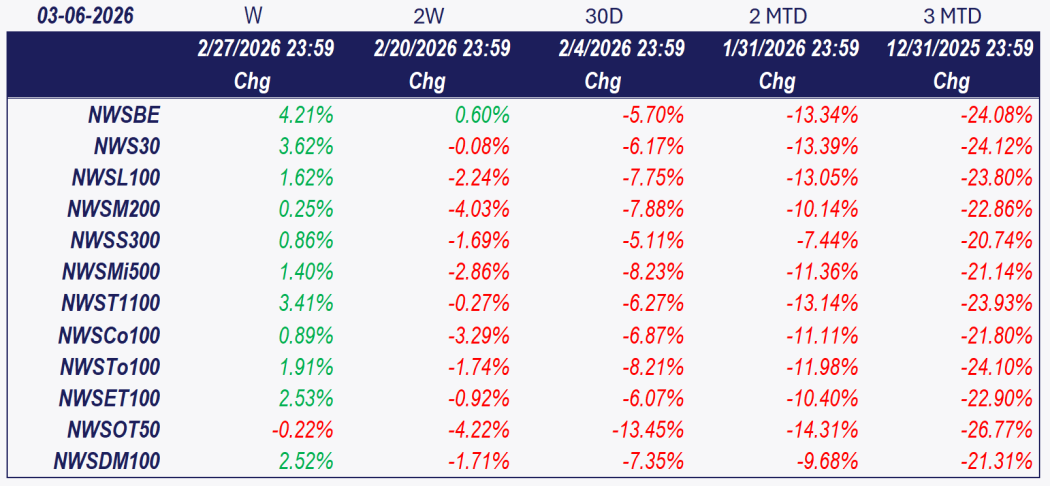
Investors and traders rely on historical performance data to contextualize short-term moves and assess the relative strength of different market segments. The latest table shows a rise across most categories, with the NWST1100 index rose 3.41% over the past week. 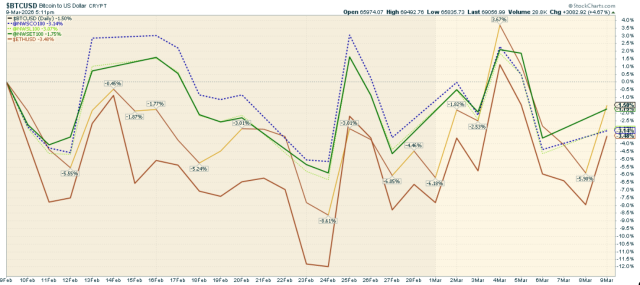 The chart above highlights the performance of various cryptocurrencies, including Bitcoin, Ether, and the 2100NEWS Indices, which represent Ethereum-based tokens (NWSET100), large caps (NWSL100), and Coins (NWSCo100). Over the past 30 days, Bitcoin emerged as the strongest relative performer and was the least damaged, posting the smallest loss of 1.50%.
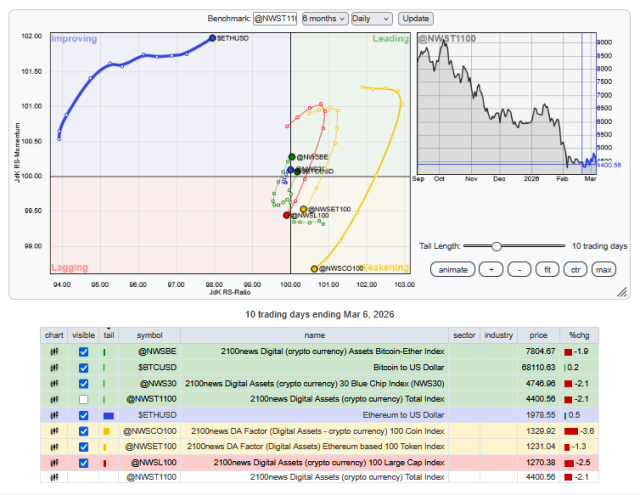
While the broader market has fallen, different segments and individual cryptocurrencies exhibit distinct performance dynamics.
Performance Trends by Market Segment:
✔ Bitcoin, NWS30, and NWSBE led the market,
✔ Ether has been improving.
✔ NWSCo100 (Coins) and NWSET100 (Ethereum-based tokens) have been weakening.
✔ NWSL100 (Large Caps) lagged.
Investors and traders might use this information to adjust their portfolios, possibly shifting focus toward assets with stronger relative momentum while being cautious about those in the Weakening quadrant.
*RRG® charts show the relative strength and momentum of groups of digital assets. Those with strong relative strength and momentum appear in the green Leading quadrant. As relative momentum fades, they typically move into the yellow Weakening quadrant. If relative strength then fades, they move into the red Lagging quadrant. Finally, when momentum picks up again, they shift into the blue Improving quadrant.
Crypto (Digital Assets) compared with global equity
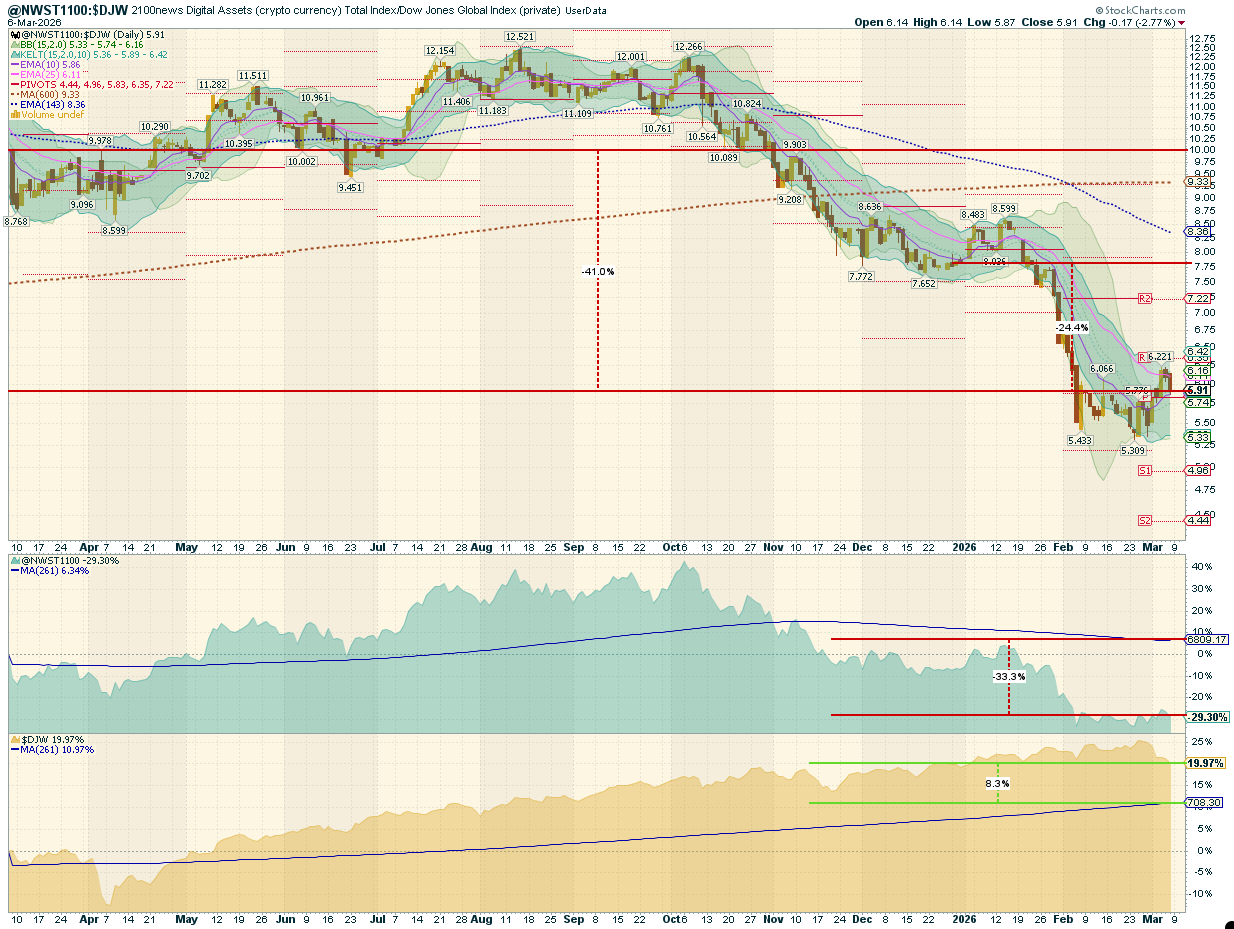
This report offers a comprehensive analysis comparing the performance of digital assets, as measured by the NWST1100 index, to that of shares on global capital markets, as represented by the Dow Jones Global W1Dow index. The comparison spans multiple timeframes, providing insights into historical and recent performances and potential future trends.
Let’s break down the key observations and implications:
- Historical Performance Comparison:
- 52 Months Ago: Digital assets vastly outperformed global equities in global capital markets, reaching a record high in the comparative quotient between the NWST1100 and W1Dow indexes. At this juncture, digital assets displayed a notably superior performance trajectory compared to shares on global capital markets.
- Over the past twelve months, digital assets have underperformed equities by 41.0%.
- Mean Reversion Opportunity:
- Over the past 143 working days, the average quotient price, represented by the blue-dashed curve, stands at 8.36, while the current spot ratio is 5.91, which is lower than the long-term mean of 9.33, which has increased since October 2024.
- The mean-reversion theory posits that asset prices tend to revert to their historical average returns over time. The current NWST1100-to-DJW price ratio, which is below the long-run mean, may indicate that digital assets are undervalued relative to historical trends.
- Returns Comparison:
- The chart also presents the returns achieved by the simplified index-based accumulation approach—buying one index point per day over 12 months—to simulate the mechanical accumulation of exposure. While this method is not equivalent to classical dollar-cost averaging (which involves investing a fixed amount of capital daily), it provides a consistent benchmark for comparing historical costs and returns. The NWST1100 Crypto Index has dropped by 29.30% over the past twelve months. With daily index investments, an investor’s stock price would have resulted in a 33.3% loss from the current index price, due to unprofitable purchases at high entry prices during a prolonged market uptrend, when prices remained above the 143-day moving average for an extended period.
- The DJW, a broad-based global equity index, has risen 19.97% over the past 12 months. However, a daily-purchase strategy would have yielded a 8.3% gain.
- Conclusion:
*The box in the middle of the chart shows the original NWST1100 price; at the bottom is W1Dow.
 Lily
Lily


 Litecoin