


2100NEWS WEEKLY CRYPTO REPORT Mar-13

The NWST1100 index rose 3.55% last week; Render (RENDER), a large-cap Ethereum-based Token, has made the most significant leap in rank within the NWSL100 crypto index on a biweekly basis.
*Below, we present a standardized weekly report and next week’s outlook, prepared based on the Theory Swingtum of intelligent finance. We gauge the crypto market’s breadth and direction by showing the 2100NEWS Digital Assets Total Index (NWST1100), which measures the performance of 1100 (by market capitalization) significant crypto assets. The information-dense chart is initially complex to read, but it clearly displays essential price information, key decision-making levels, momentum, trading volumes, and crypto market breadth. Monitoring Market Sentiment and Breadth is necessary to detect early signs of trend reversals or continued strength.
Our detailed analysis of the NWST1100 chart and related market indicators reveals essential insights into the current market conditions:
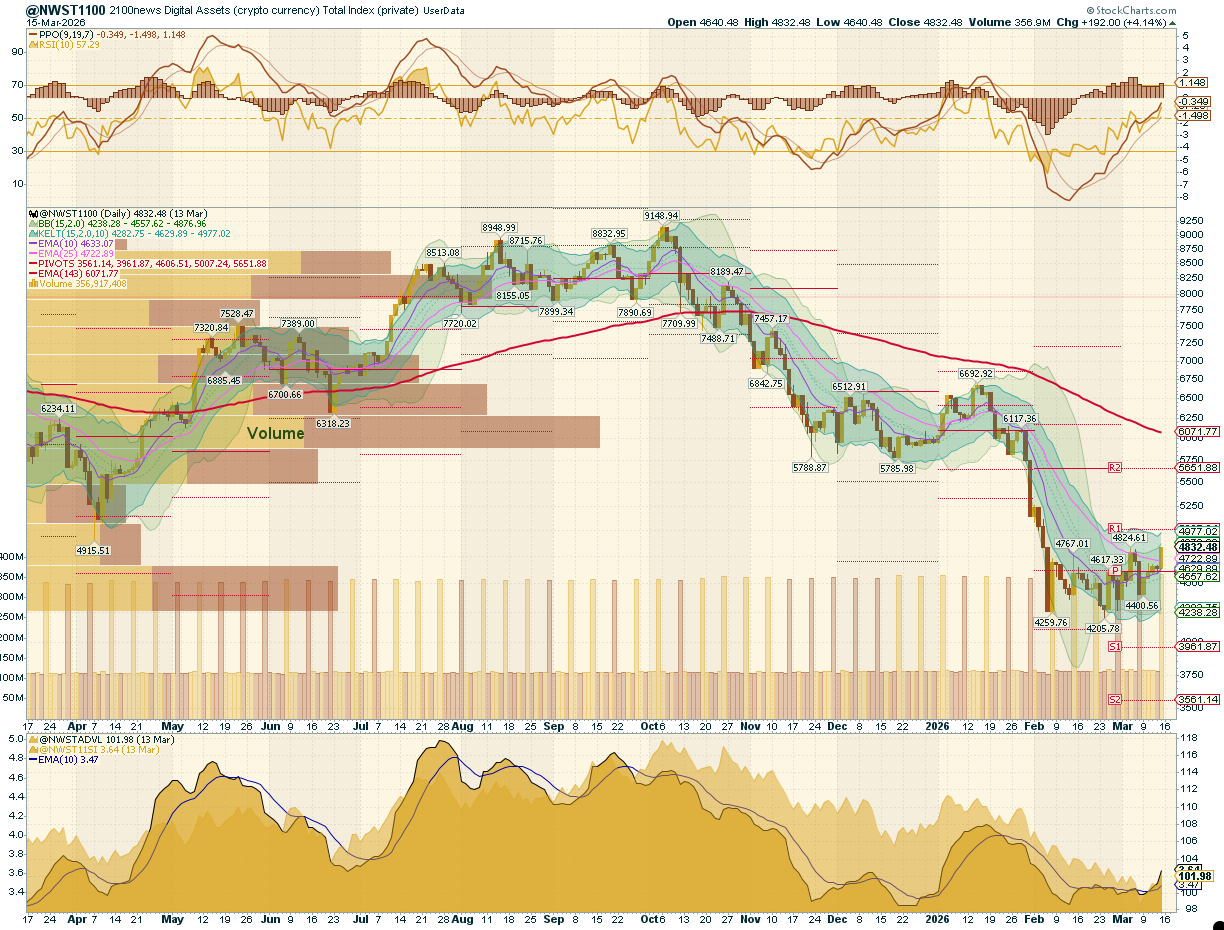
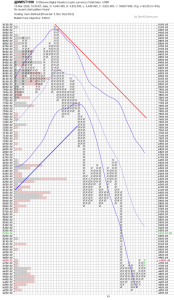
The NWST1100 index rose 3.55% over the past week, extending the prior week’s advance and, more importantly, delivering a structurally stronger outcome than the earlier March recovery attempt. The week began with consolidation above the recently reclaimed support shelf, followed by a steady sequence of higher lows and a decisive push through the 4,750–4,800 resistance zone. Unlike the previous breakout test, this move did not immediately fail. Instead, the market held its gains and finished the week near the highs, confirming that price has now moved beyond the earlier repair range and into the next phase of recovery. Structurally, the market shifted from range repair into an early breakout regime. 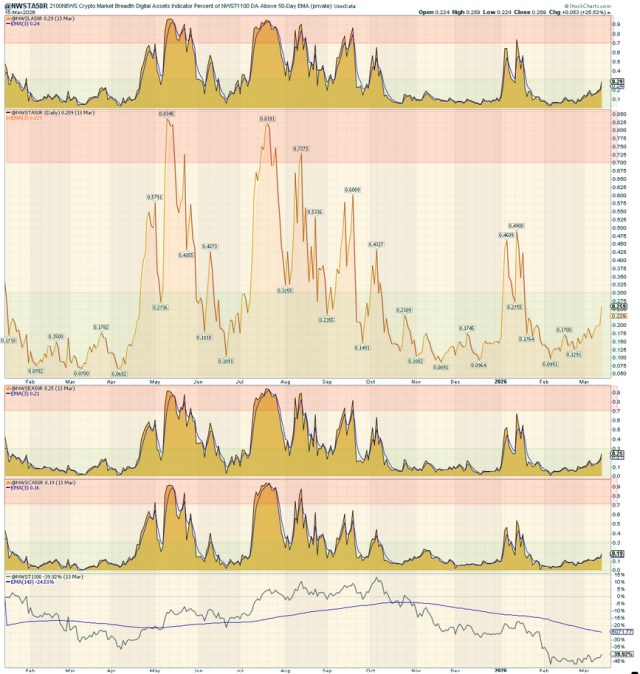
- Market sentiment: Momentum improved meaningfully and is now close to a formal regime transition. PPO lines remain slightly negative but continue to rise sharply toward the zero line, confirming that the higher-timeframe bearish trend is still being neutralized rather than already reversed. At the same time, the PPO histogram remained positive and continued to expand, indicating that upside momentum is still building rather than merely stabilizing. The RSI finished near 57, clearly above neutral and well above the post-capitulation repair zone of previous weeks. This is no longer the signature of a market merely digesting prior losses. It is consistent with early expansion momentum, albeit still beneath major long-term overhead resistance.
- Attention has also shifted toward breadth metrics at the bottom of the NWST1100 chart. Breadth supported the price advance rather than contradicting it. The Advance-Decline Volume Line (ADVPL) — 2100News’s proprietary adaptation of the AD Line for the crypto market — rose materially during the week, indicating that participation broadened and that the advance was supported by expanding internal flows rather than a narrow handful of leaders. The McClellan Summation Index, a long-term breadth indicator, also rose decisively. Unlike the flatter or fading behavior seen in prior weeks, this improvement confirms that internal conditions strengthened beneath the surface and that the breakout attempt had genuine participation support.
- A50R Participation: According to the chart on the right, across all major segments (NWST1100, NWSET100, NWSL100, NWSCo100), A50R readings have improved materially. A50R ended the week roughly in the 19%–29% range. Coins (NWSCo100) remained the weakest segment. These readings are still not high enough to describe a fully healthy bull market, but they do confirm a clear move away from capitulation territory and toward broader internal repair. The market is no longer just bouncing — participation is beginning to widen.
*This breadth indicator is essential in measuring the internal strength or weakness of the underlying index. Looking at the chart on the right side, we can see the A50R lines for four different categories of digital assets:
- The top box shows the A50R lines for 100 Large-cap members of NWSL100.
- The middle box displays the A50R lines for 1100 members of NWST1100, which is the Total Index that measures the performance of significant crypto assets by market capitalization.
- The third box shows the A50R lines for 100 Ethereum Tokens members of NWSET100.
- The bottom box represents the A50R lines for NWSCo100’s 100 Coins members.
📉 Summary
The week of March 7 to March 13, 2026, was defined by constructive continuation. The market did not merely rebound; it advanced through resistance, held the breakout, and ended the week with stronger momentum and improving breadth. Price moved above the 0.236 Fibonacci threshold, PPO continued to normalize, breadth measures turned higher, and A50R participation expanded across all key segments. This still does not amount to a mature bull regime — long-term trend damage has not been fully repaired, and participation remains moderate rather than strong. However, the character of the market has improved meaningfully. The regime is now better described as early expansion after repair, rather than simple consolidation.
Outlook for the Week Ahead
This section provides a probabilistic assessment of the cryptocurrency market’s short-term trajectory. While markets remain inherently unpredictable, cyclical patterns in price behavior and momentum often reveal recurring structures that help identify the next likely phase of development.
- From a structural perspective, the market has now pushed beyond the prior 4,200–4,750 repair box and reclaimed the 0.236 Fibonacci zone around 4,800. Repeated tests of resistance often weaken it as supply is absorbed; this process now appears to have culminated in a successful breakout. The next step is not simply another rally burst, but a test of breakout durability.
- The RSI (Relative Strength Index) stood at 57 last week, suggesting that momentum has moved into constructive territory and still has room to rise before reaching overstretched conditions.
- The PPO histogram, which measures the rate of change (i.e., the first derivative) of PPO lines, remains positive but may roll over. PPO lines continue to approach the zero line; If they cross above zero in the coming sessions, that would strengthen the case that the higher-timeframe bearish phase has ended and the market is transitioning into a new upward leg.
- The Breadth indicators at the bottom of the first chart (NWST1100) may continue advancing. The Advance-Decline Volume Line (ADVL), adapted by 2100News for the crypto market as ADVPL, tracks the net money volume of advancing versus declining digital assets. It may continue to rise. The McClellan Summation Index, a long-term measure of market breadth, may rise, indicating expanding participation beneath the surface.
📌 Target and Scenario Considerations:
The most probable outcome for the coming week is the breakout above 4,750–4,800, followed by an attempt to establish a higher support zone above the former ceiling. If this holds, the market may continue toward the next technical objectives, with the R1 resistance near 5,300 offering a reasonable upper reference. A failure back below the reclaimed 4,750–4,800 zone would weaken the immediate bullish case.
📍 Key Levels to Watch:
-
Support: 4,800 ( 0.236 Fibonacci retracement, former resistance, now first breakdown test zone)
-
Resistance: 5,000 (pivot R1), 5,300 (P&F bullish objective)
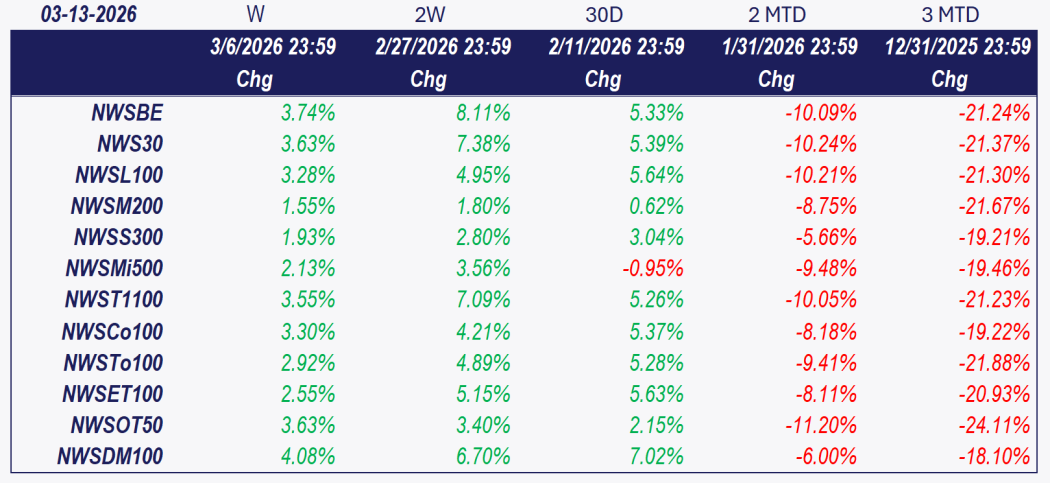
Investors and traders often rely on historical performance data to make informed decisions about their cryptocurrency holdings. After analyzing the table data, it is evident that the weekly advance was broad-based, with blue chips, large caps, and the total market all participating; the overall index rose by 3.55% over the last week. 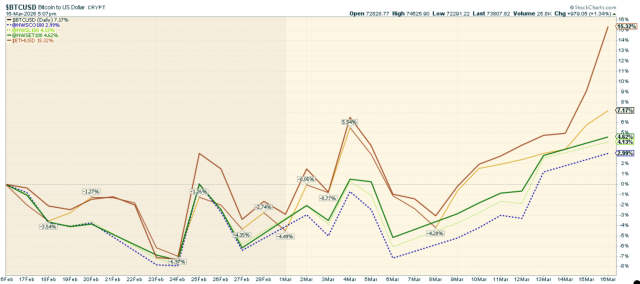 The accompanying chart highlights the performance of key cryptocurrencies, including Bitcoin and Ether, alongside the 2100NEWS Indices, which track Ethereum-based tokens (NWSET100), large caps (NWSL100), and coins (NWSCo100). Among these, Ether was the strongest performer by far, up about 15.3% over the past thirty days.

While the broader market has advanced, different segments and individual cryptocurrencies exhibit different performance dynamics.
Performance Trends by Market Segment:
✔ Ether, NWS30, Bitcoin, and NWSBE led,
✔ NWSCo100 (Coins), NWSET100 (Ethereum-based tokens), and NWSL100 (Large Caps) shifted into the lagging quadrant, suggesting early potential for renewed relative strength.
Investors and traders may use this information to adjust their portfolios, shifting focus toward assets with stronger relative momentum while remaining cautious about those in the Weakening quadrant.
*RRG® charts show the relative strength and momentum of groups of digital assets. Those with strong relative strength and momentum appear in the green Leading quadrant. As relative momentum fades, they typically move into the yellow Weakening quadrant. If relative strength then fades, they move into the red Lagging quadrant. Finally, when momentum picks up again, they shift into the blue Improving quadrant.
Crypto (Digital Assets) compared with global equity
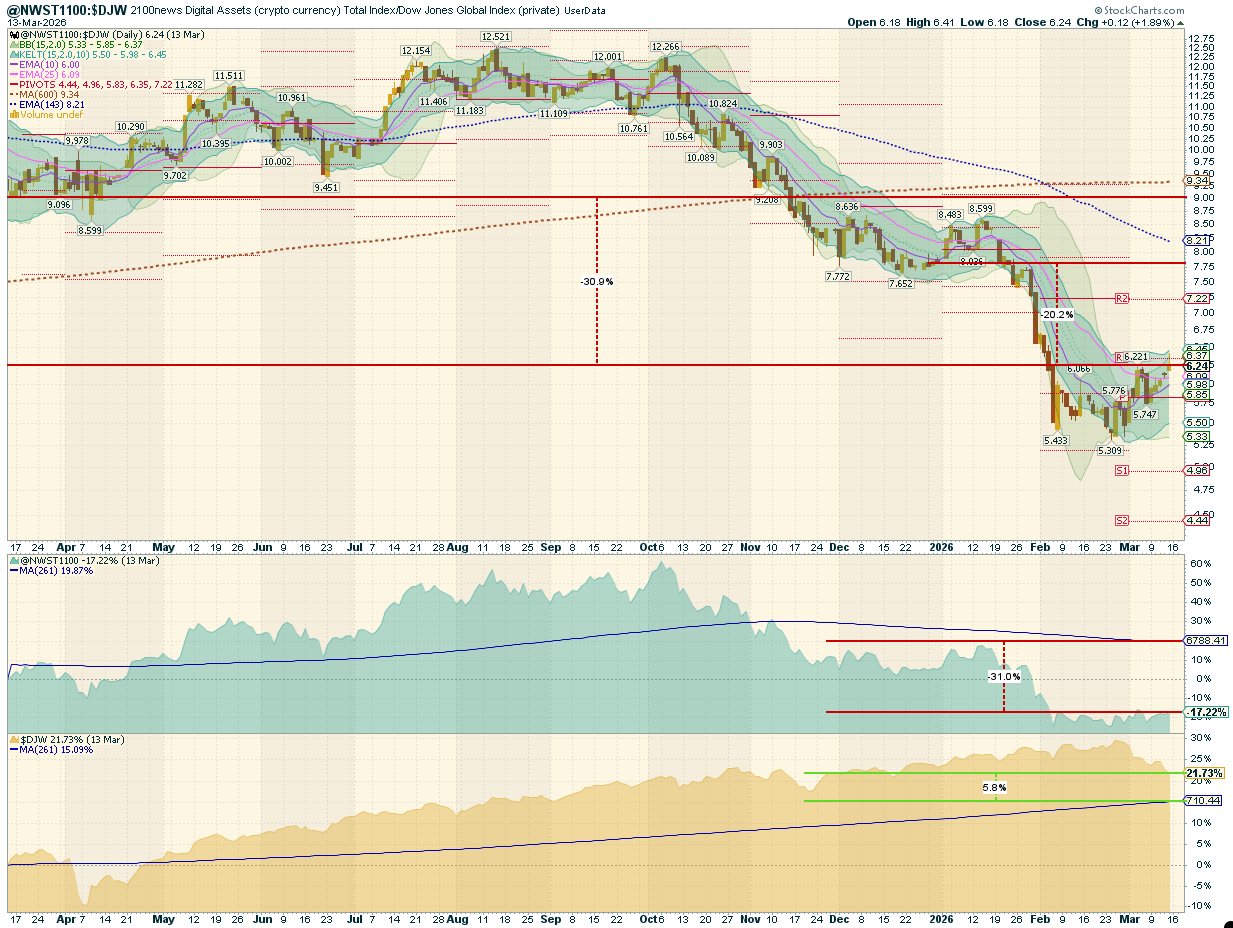
This report offers a comprehensive analysis comparing the performance of digital assets, as represented by the NWST1100 index, with that of shares on global capital markets, as measured by the Dow Jones Global W1Dow index. We draw insights into historical achievements and potential future trends by examining their performances across various time frames.
Let’s break down the key observations and implications:
- Historical Performance Comparison:
- 52 Months Ago: Digital assets vastly outperformed global equities in global capital markets, reaching a record high in the comparative quotient between the NWST1100 and W1Dow indexes. At this juncture, digital assets displayed a notably superior performance trajectory compared to shares on global capital markets.
- Over the past twelve months, digital assets have underperformed equities by 30.9%.
- Mean Reversion Opportunity:
- The average quotient price, represented by a blue dashed curve, has been 8.21 over the past 143 working days, while the current spot ratio is 6.24. This is lower than the long-term mean of 9.34, which has increased since October two years ago.
- The mean reversion theory suggests that asset prices tend to revert to their historical average returns over time. The current NWST1100-to-DJW price ratio, which is below the long-run mean, may indicate that digital assets are undervalued relative to historical trends.
- Returns Comparison (12-month Accumulation Method) & Strategic Investment Timing:
- The chart also presents the returns achieved by the simplified index-based accumulation approach—buying one index point per day over 12 months—to simulate a mechanical build-up of exposure. While this method is not equivalent to classical dollar-cost averaging (which involves investing a fixed amount of capital daily), it provides a consistent benchmark for comparing historical costs and returns. The NWST1100 Crypto Index has dropped by 17.22% over the past twelve months. With daily index investments, an investor’s stock price would have resulted in a 31.0% loss from the current index price, due to unprofitable purchases at high entry prices during a prolonged market uptrend, when prices remained above the 143-day moving average for an extended period.
- The DJW, a broad-based global equity index, rose 15.09% over the past 12 months. However, a daily purchase strategy would have resulted in an 5.8% gain.
- Conclusion:
*The box in the middle of the chart shows the original NWST1100 price; at the bottom is W1Dow.
Indices Revision 3-13-2026
Following the latest biweekly revision, several adjustments were made to the mid-cap index (NWSM200), with new projects introduced and weaker ones removed, reflecting the ongoing dynamism of that segment. The new mid-cap assets, including Plume Network, Centrifuge, and QASH, have been added to the NWSM200 index. Each index’s presentation provides more details on additions and deletions across the broader 2100NEWS index family.
Winning member
Congratulations to Render (RENDER) on achieving a significant milestone: being recognized as the winning member of the NWSL100 crypto index, marking a crucial leap in the ranking of index constituents.
*We elect the member of the NWSL100 crypto index with the most significant jump in our ranking. We will examine how the market rates the project’s progress in case of price changes. It seems important to us whether the project is out of the ordinary tide of crypto project prices. Peer comparisons should be efficient and effective, from an investor’s perspective.

Render (RENDER) https://rendernetwork.com/
RENDER, a large-cap Ethereum-based token, ranks 54th in the 2100NEWS ranking. It is an Index member: NWST1100, NWSL100, NWSTo100, NWSET100
2100NEWS DA Orderbook Quality Evaluation Grade: Poor, Score: 14.5, (Average for Large-caps: 17.1)
Over the past week, the average market capitalization was $802.6 million, and the average daily trading volume was $60.6 million.
Render (RENDER) is a decentralized GPU computing network that creates a peer-to-peer marketplace for rendering and AI workloads. By connecting creators with a global pool of idle GPUs, the network offers a scalable and cost-efficient alternative to centralized cloud providers. Built on Solana for high-throughput coordination, Render distributes jobs across node operators who process tasks such as 3D rendering, visual effects, and AI computation. Completed work is verified through a Proof-of-Render system before payments are released. The RENDER token powers the ecosystem through a burn-and-mint equilibrium model—users burn tokens to pay for compute jobs while operators receive newly minted tokens as rewards. This design aligns network incentives with demand for GPU power, positioning Render as a key infrastructure layer for AI, gaming, and digital content creation.

 Lily
Lily


 Litecoin